

Building a Not-So-Perfect Resume
Whether you're applying for your first professional job, returning to work after several years away, changing careers, or simply looking for your next opportunity, you need to create a resume.
And I get it. Ugh.
For many people, creating a resume feels overwhelming. What should you include? What should you leave out? How do you describe years spent raising a family, serving in your community, or working in a role that doesn't seem directly related to the job you want?
I can’t tell you how many women have said to me, “I need to go back to work, but I have no skills.”
NOT TRUE!
But I get it. What you really mean is, I don’t know how to write about or quantify the things I’ve done.
Not to worry. We're not trying to build the perfect resume today. We're simply creating a strong foundation that you can improve throughout your career.
 There's a free resume template at the end of this article.
Over the years, I've written resumes for clients in every stage of life—from college students to parents returning to the workforce to seasoned professionals making a career change. I've also reviewed hundreds more. Although every situation is different, the resumes that consistently lead to interviews have several things in common.
In this guide, I'll walk you through the same principles I teach my coaching clients so you can build a resume that is clear, professional, and ready for today's hiring process.
Who Are You Writing Your Resume For?
Your resume has two audiences: people and Applicant Tracking Systems (ATS).
So...what's an ATS?
An ATS is software many employers use to collect and organize job applications. Basically, it's what you're using every time you fill out an online application. (You're the applicant being entered into—and then tracked through—the system.)
Whether a company uses BambooHR, iCIMS, Greenhouse, Workday, or another platform, the system scans your resume and other application materials, organizing the information into a searchable database. That allows recruiters to search for and rank candidates whose experience and qualifications best match the position.
Instead of reading your resume the way a recruiter would, the ATS organizes your information into searchable fields and compares it against the employer's requirements.
Depending on the system and how it's configured, it may look for things like:
- Years of experience in a particular role or industry
- Keywords that match the job description
- Skills, software, certifications, and technical proficiencies
- Employment dates to determine how long you've used a particular skill
- Education, degrees, graduation dates, or GPA (when required)
- Required licenses or certifications
- Job titles and career progression
- Leadership experience or collaboration on relevant projects
Some employers also use knockout questions during the application process. You won't know what they are, so the only thing you can do is create the best possible resume and trust the process. Knockout questions may be things like whether you have a required certification, are authorized to work in the country, have a minimum GPA, or possess five or more years of experience in a particular field. If you don't meet a required qualification—or your resume doesn't clearly demonstrate it—it gets "knocked out."
Got Auto-Rejected?
A client of mine once got "knocked out" after a recruiter specifically asked him to apply for a job. When he told the recruiter he got auto-rejected immediately, the recruiter reviewed his application and told him that he got knocked out for living too far from the office. The recruiter overrode the knockout and invited him to an interview.
Lesson to learn? Follow-up if you think your application got eliminated too quickly.
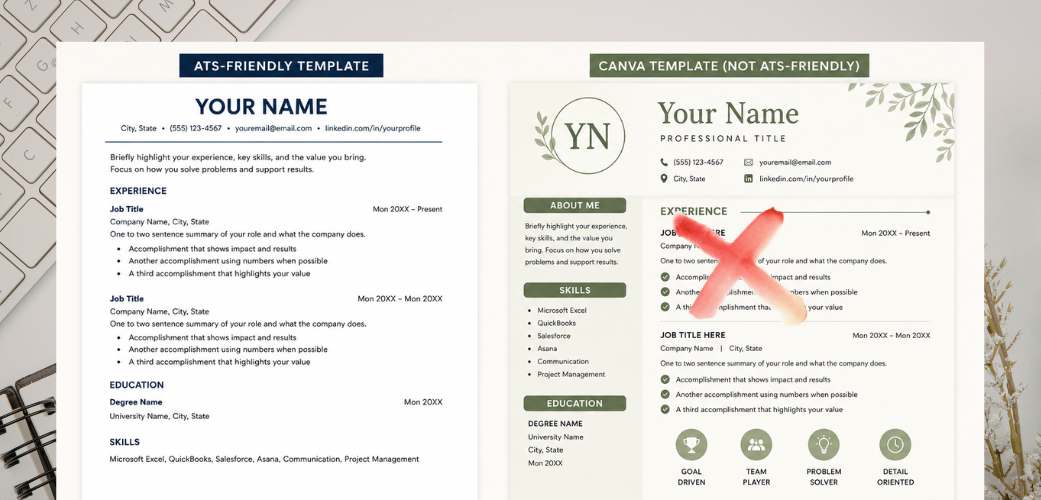
Because the ATS is trying to determine how well your experience matches the job requirements, your resume needs to be painfully clear, organized, and easy for a computer to read.
I know those beautifully designed Canva templates are tempting, but they're often difficult for ATS software to interpret. Multiple columns, graphics, icons, text boxes, and unusual formatting can make it harder for the system to correctly identify your experience, skills, and dates of employment. If the ATS can't read the resume or parse the text into relevant fields, your resume will be outranked by other applications that are easier to read.
Then, after all that, a person has to be able to read your resume too. No problem. If your resume is clean, organized, and easy for a computer to understand, it'll be easy for a person to read too.
At this stage, your resume has one job: earn you an interview.
So let's break down each part of a resume.
Oh, and before we do...one more thing.

You're going to get conflicting resume advice. One expert will tell you to include a professional summary. Another will say never use one. Some insist every resume should be one page. Others say two pages are perfectly acceptable. You'll hear conflicting opinions about fonts, colors, skills sections, and just about everything else.
And, to be fair, my advice may simply become part of that noise.
But here's what I can tell you.
The recommendations in this guide come from years of writing resumes and seeing people's interview rates improve after making these changes. They're based on what I've seen work across different industries, career stages, and hiring situations.
That said, if a recruiter or hiring manager tells you exactly what they want to see for their position, do that. Follow their instructions to a tee.
If someone else offers advice, listen. Prayerfully consider it. Then decide what makes the most sense for your situation.
Ultimately, this is your resume, your job search, and your life. You need to feel good about it. I'm simply here to share what I've learned and help you put your best foot forward.
Below are the SEVEN main parts of a resume. We'll look at each section, discuss what belongs there, and talk about a few common mistakes to avoid.
1. Contact Information
This is the simplest section of your resume. Your goal is to make it easy for the recruiter to be able to contact you.
Include:
- Your name
- Phone number
- A professional email address
- Your LinkedIn profile URL (get it up to date)
You no longer need to include your full mailing address. In most cases, your city and state aren't necessary either unless you want employers to know you're local.
For example, if your phone number has a Utah area code but you're applying for a job in Boston, you may want to include "Boston, MA" in your contact information or mention that you're relocating in your professional summary or cover letter. That simple addition can reassure employers that you're serious about the position and help avoid questions about your location.
And now is a good time to make sure you have a professional email address. If your email is still soccermom1998@email.com or cutiekat17@email.com, it's time to create a simple and professional email address using your name.
2. Professional Summary
After your contact information, you'll probably notice a short paragraph at the top of many resumes. That's your professional summary. Not everyone agrees with me on this, but I like including one. It gives recruiters a quick snapshot of your background, highlights your most relevant qualifications, and helps them quickly understand who you are. It's also a great place to mention details that don't fit naturally elsewhere, such as relocating to Boston or returning to work after a five-year parenting gap.
It goes at the top...but I write this last.
By the time you've documented your work experience, education, volunteer leadership, technical skills, and accomplishments, you'll have a much better understanding of the story your resume tells. Writing the summary becomes much easier because you're summarizing what you've already written—not trying to invent it from scratch.
And you don't need to a "Professional Summary" headline. Just launch into it.
We'll come back and write this section after the rest of your resume is complete.

3. Experience
This is the most important section of your resume. This section does much more than list job titles. It tells the story of your career and provides evidence that you have the skills and experience to succeed in the position you're applying for.
For that reason, I simply call this section Experience rather than Work Experience.
If you have years of professional experience, you may choose to separate volunteer work into its own section near the end of your resume. That's perfectly fine. But if you're early in your career, returning to work after time away, changing careers, or simply have longterm volunteer leadership to showcase, I recommend combining paid and unpaid experience into one section.
If, for example, you spent five years as the fundraising chair for a nonprofit, increased donations, coordinated volunteers, managed budgets, and planned events, those accomplishments don't become less valuable because you volunteered your time.
Recruiters care far more about what you accomplished than whether someone issued you a paycheck.
Now, let's start building it.
Step 1: Create an Entry for Each Experience
For each professional (or significant volunteer) experience you've had, list the following:
- Job title or job summary
- Organization with city and state
- Dates of employment or service (start and end date including month and year)
- A brief description of the role (optional)
- Three to six accomplishment bullets (see below)
Quick note on job titles: It's okay to clarify or slightly modify your job title to more accurately reflect the work you actually did. The goal is to help employers quickly understand your experience—not to inflate it. Just make sure it's honest and wouldn't surprise your former employer.
For example, your payroll system might have classified you as a Secretary, but if your responsibilities were much closer to an Office Manager and Administrative Assistant, it's reasonable to use a title that better reflects the work you performed.
Another quick note about job descriptions: If you have the space, I like including a two or three-sentence description of the role before the accomplishment bullets. It provides additional context, naturally adds relevant keywords, and helps employers understand the scope of your position before they read your accomplishments. If you're trying to fit everything onto one page, this is usually one of the first things I'd remove. Your accomplishment bullets are much more valuable than a description of your responsibilities. (You may hear conflicting advice on this, but from a "scan and search" perspective, the more keywords you have aligned to dates, the better.)
Step 2: Add Accomplishments-Based Bullets
For each experience, ask yourself:
- What problems did I solve?
- What did people rely on me for?
- What was I especially good at?
- What did I improve?
- What tools, software, or systems did I use?
- Did I train anyone?
- Did I organize something?
- Did I save time, increase participation, reduce costs, or improve a process?
- What did people compliment me on?
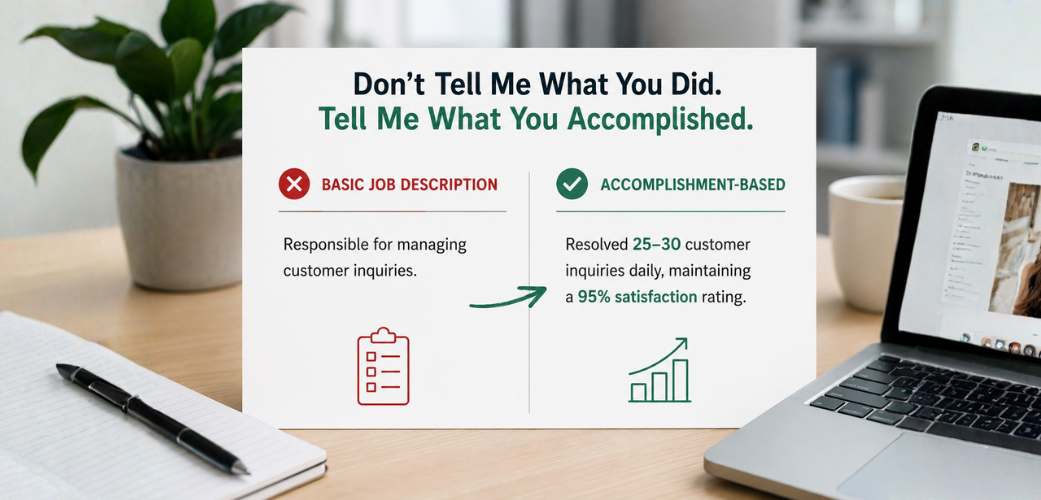
Now turn those answers into accomplishment bullets. Each bullet should describe what you did, the skills or tools you used, and the impact you made. Be as specific as possible.
Here's why that matters. If a job requires three to five years of experience with SQL in a technology company, then your resume needs to show that you used SQL in a technology company—and that you did it for at least three years. Simply listing SQL in a Skills section isn't enough.
Think of it this way. An ATS isn't just looking for keywords. It's trying to connect those keywords to real experience and measurable timeframes.
So instead of seeing this:
Skills: SQL, Excel, Power BI
…it wants to see something like this:
Data Analyst | ABC Technology | January 2020–April 2024
- Used SQL to analyze customer data, build custom Tableau reports, and support 8 business units
Now the ATS can connect SQL, Data Analyst, technology company, and four years of experience.
Well-written accomplishment bullets help the ATS recognize that you're a strong match for the position. Then, once your resume reaches a recruiter or hiring manager, those same bullets help them quickly understand your qualifications. Later, during the interview, those bullets become the stories you tell to demonstrate your experience.
In other words, your accomplishment bullets become the foundation for your entire job search.
Step 3. Add Metrics
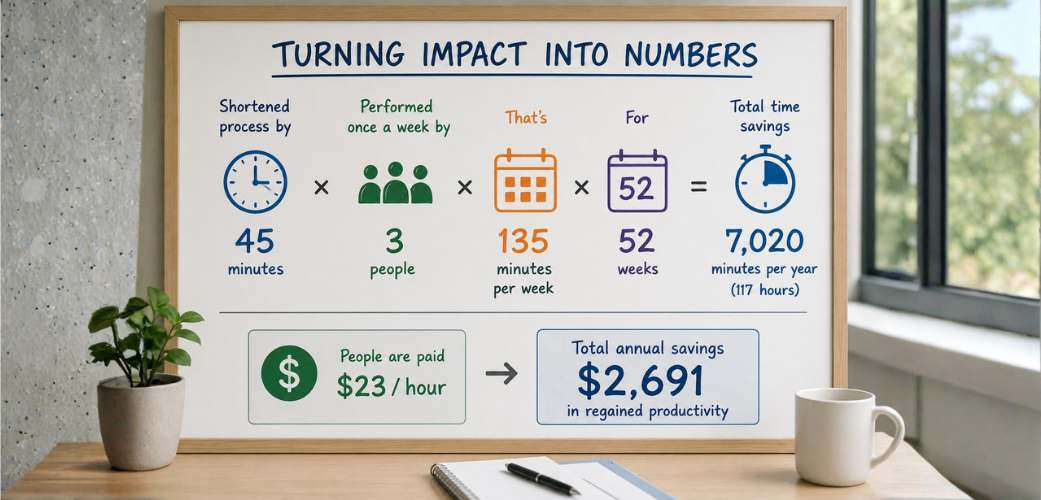
Whenever possible, quantify your accomplishments with numbers, metrics, or measurable results.
Sometimes the metrics are obvious:
- Served 40–50 customers daily while ranking #1 in sales volume for eight consecutive months
- Managed a $250,000 annual budget…
- Supervised a team of 12 employees…
Other times, you may need to think a big. Ask yourself, "How did I make this job better?"
For example, maybe you were trained to design one office space per day. At first, you met that expectation. Then you identified ways to streamline the process using AI to reduce repetitive tasks. As a result, you increased your productivity by 25% while maintaining a high-quality, personalized experience for every customer.
That's the difference between describing your responsibilities and demonstrating your impact.
Compare this bullet:
- Responsible for managing office operations and conference room scheduling
To these bullets:
- Managed daily operations for 25-person office, reducing administrative bottlenecks and improving team efficiency
- Introduced shared Outlook calendar for room reservations, eliminating 5+ weekly double-booked meeting spaces
Notice that the second bullet shows the before and after. Before implementing the new system, meeting rooms were double-booked several times each week. Afterward, scheduling conflicts became rare and typically occurred only when someone forgot to use the reservation system.
If each scheduling conflict delayed 8 employees by 10 minutes, eliminating 5 conflicts a week would save more than 300 hours of employee time over the course of a year. At an average labor cost of just $20 per hour, that's more than $6,000 in regained productivity. In reality, the savings were probably much higher. Thinking through the ripple effects of your work often reveals accomplishments you didn't realize you had and makes the metrics much easier to identify.

Step 4: Make Every Bullet Defensible
Now, to be clear, I'm not saying to fabricate metrics. Be honest, be specific, and quantify your impact whenever you reasonably can. Your estimates don't have to be perfect, but they do need to be defensible.
I want you to be able to look at every bullet on your resume and confidently explain it in an interview.
"Yes, our conference rooms kept getting double-booked because we used a paper calendar taped to the door. People didn't always check it before scheduling meetings, so we'd have conflicts several times a week. We'd stop the meetings, figure out which group had priority, find another room, and wait for everyone to get settled. It wasted a surprising amount of time, so I introduced a shared Outlook calendar. The conflicts almost disappeared."
That's a story. And stories with actions and results get people hired.
The Most CRITICAL Question
For every job you've ever had, ask yourself one question: What did people compliment me on?
I can say this with almost 100% certainty: whatever people noticed about you in your first job is probably what they'll notice about you in your tenth. Maybe it's your diligence. Your willingness to help. Your organization. Your efficiency. Your ability to solve problems. Your creativity. Your attention to detail.
Those qualities are part of your career DNA.
One of the most rewarding parts of writing a resume is discovering those themes. Once you recognize them, you'll start seeing them everywhere—on your resume, in your interviews, on LinkedIn, and even in the kinds of opportunities that excite you.
So don't skip this step. It may teach you as much about yourself as it teaches employers about you.
4. Education
Once you've finished your experience section, your education comes next.
(For my college students, I actually put Education and Skills near the top of the resume because those sections are often what early-career recruiters are looking for. But for most professionals, experience carries much more weight, so education naturally moves toward the end.)
Include:
- School name
- Degree earned (or expected)
- Graduation month and year (or expected graduation date)
- Relevant honors or academic distinctions, if applicable
- Relevant coursework if recent and related to the job you’re applying for
If you graduated several years ago, there's no need to include your GPA unless an employer specifically requests it or it's particularly exceptional.
If you attended college but didn't complete a degree, list the school and the years attended, or any certificate or coursework that's relevant to the position.
Keep this section simple. Your education helps complete your professional story, but by this point, employers are much more interested in the experience and accomplishments you've already shared.
5. Skills & Certifications
The Skills & Certifications section is exactly what it sounds like: a quick snapshot of the technical skills, software, certifications, languages, or areas of expertise you bring to the table.
I know it's tempting to use logos, icons, or multiple columns, but resist the urge. Remember, your resume still needs to be easy for an Applicant Tracking System to read.
A clean, single-column list is usually your best option.
Software: Excel, QuickBooks, Canva, Salesforce
Project Management: Asana, Trello, Monday.com
Languages: Spanish (Conversational)
Certifications: CPR, SHRM-CP
The categories you use will depend on your industry and level of experience.
For example, my Information Systems students often have multiple lines of programming languages, databases, cloud platforms, operating systems, analytics tools, and certifications because those technical skills are central to the jobs they're applying for. For many other professions, a shorter section is perfectly appropriate. An administrative professional might emphasize software, office systems, and certifications. A teacher might include educational technology, curriculum development, and languages. A nurse might highlight clinical skills, electronic health record systems, and certifications.
As you review job postings and begin applying, you'll naturally discover skills, keywords, and better ways to describe your experience. That's normal. Your resume should continue to evolve throughout your job search.
If you notice, for example, that employers consistently use the title Implementation Specialist instead of Integration Specialist, or they refer to Customer Experience rather than Customer Support, consider updating your resume to better match the language used in your industry.
6. Volunteer Experience (Optional)
Whether you need a separate Volunteer Experience section depends on the role and your career history.
If your volunteer work demonstrates transferable skills, significant leadership, measurable accomplishments, or is directly relevant to the jobs you're pursuing, I recommend including it in your Experience section alongside your paid positions. Employers care much more about what you accomplished, and for how long, than whether you were paid.
If you simply want to acknowledge ongoing volunteer service, a separate Volunteer Experience section near the end of your resume works well. In most cases, these entries can be simple one-liners that include the organization, your role, and the dates you served.
For example:
7. Additional Achievements & Interests (Optional, but my Favorite)
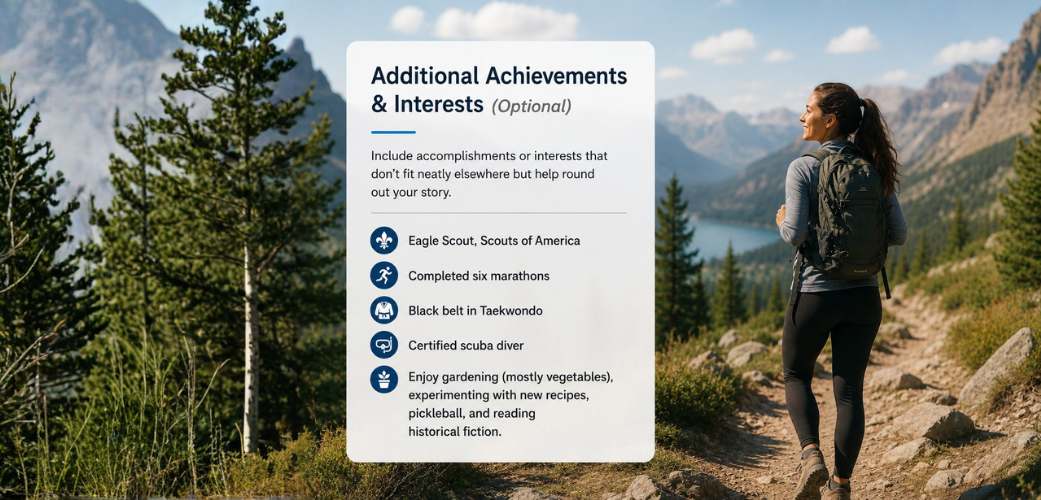
This section is optional, but it can help employers see you as a whole person—not just a list of jobs and skills. In my experience, it's also where a recruiter's eyes land as they scan your resume. It makes you memorable and frequently becomes the first thing they ask about.
"Oh, I see you like hiking. Have you ever been to Glacier National Park?"
"You ran six marathons? That's impressive. Which one was your favorite?"
Small conversations like these help build rapport and put you at ease before the interview even begins.
For example:
- Eagle Scout, Scouts of America
- Completed six marathons
- Black belt in Taekwondo
- Certified scuba diver
- Enjoy gardening (mostly vegetables), experimenting with new recipes, pickleball, and reading historical fiction.
Don't add interests just to fill space. Include things that genuinely reflect who you are and that you'd enjoy talking about if someone asked.
Now Back to Your Professional Summary
At this point, you've identified your experience, accomplishments, skills, education, volunteer work, and other highlights. You know the story your resume tells.
Now all you need to do is summarize it.
Keep your professional summary to two or three sentences. Introduce yourself professionally, highlight your biggest strengths, and briefly explain the value you bring. If you're changing careers or returning to the workforce, this is also a good place to provide a little context.
For example:
Administrative professional with 12 years of experience supporting executive teams, improving office operations, and coordinating complex projects. Recognized for creating efficient systems, solving problems proactively, and building strong relationships with colleagues and clients. Proficient in Microsoft 365, QuickBooks, and project management software.
Project manager returning to the workforce after several years focused on family and community leadership. Experienced in QuickBaooks budgeting, volunteer management, fundraising, event planning, and process improvement, with a proven ability to organize complex projects, lead teams, and build strong relationships.
Customer service professional transitioning into customer success after eight years of building client relationships, resolving complex issues, and improving customer satisfaction. Known for strong communication, problem-solving, and a commitment to helping customers achieve long-term success.
Your professional summary isn't meant to tell your entire story. It's simply an introduction that encourages the reader to keep reading.

Lastly, Tailor Your Resume Before You Apply
Congratulations! You have a master resume.
Now (gulp), you'll want to customize it. Before submitting an application:
- Read the job description carefully.
- Highlight the skills, software, certifications, and responsibilities that appear repeatedly.
- Compare those requirements to your resume.
- Emphasize the experiences and accomplishments that best demonstrate your qualifications.
- Update your professional summary, skills section, and accomplishment bullets using the same language the employer uses—provided it accurately describes your experience.
You should never fabricate experience or claim skills you don't have. But you should absolutely describe your experience using the language employers recognize.
That's exactly how it's supposed to work.
Your resume isn't a document you write once. It's a document that grows with your career.
Ready to Write Your Resume?
Here's a free, ATS-friendly resume template based on the same structure I use with my coaching clients. It includes formatting guidance, examples, and tips to help you get started quickly.
You don't have to use this exact template. What you do need is a resume that's easy for both recruiters and ATS to read. Keep it clean, organized, and focused on your accomplishments—and you'll be in great shape.
Need Help with Your Resume?
Writing a resume isn't hard—but sometimes you're simply too close to the puzzle.
It's like trying to read the label from inside the bottle. You know your own experiences so well that it's easy to overlook accomplishments, underestimate your skills, or struggle to describe what you've actually done. That's completely normal.
If you'd like some help, I'm here.
We'll work together to rewrite accomplishment bullets and optimize your resume for ATS. It's perfect if you need a polished resume without committing to full career coaching.
Still Feeling Overwhelmed?
If you're looking for a partner throughout your job search, let's settle in and work through it together. We'll build your resume, optimize your LinkedIn profile, develop a job search strategy, practice interviewing, and create a plan that fits your goals and your life. Just hit "Get Coached" and let's get started.
Wherever you are in your career journey—returning to work, changing careers, or looking for your next opportunity—I'd be honored to help.
Everyone has valuable experience. Sometimes it just takes another person to help you see it and put it into words.
Let me know how I can help.
Shelley